
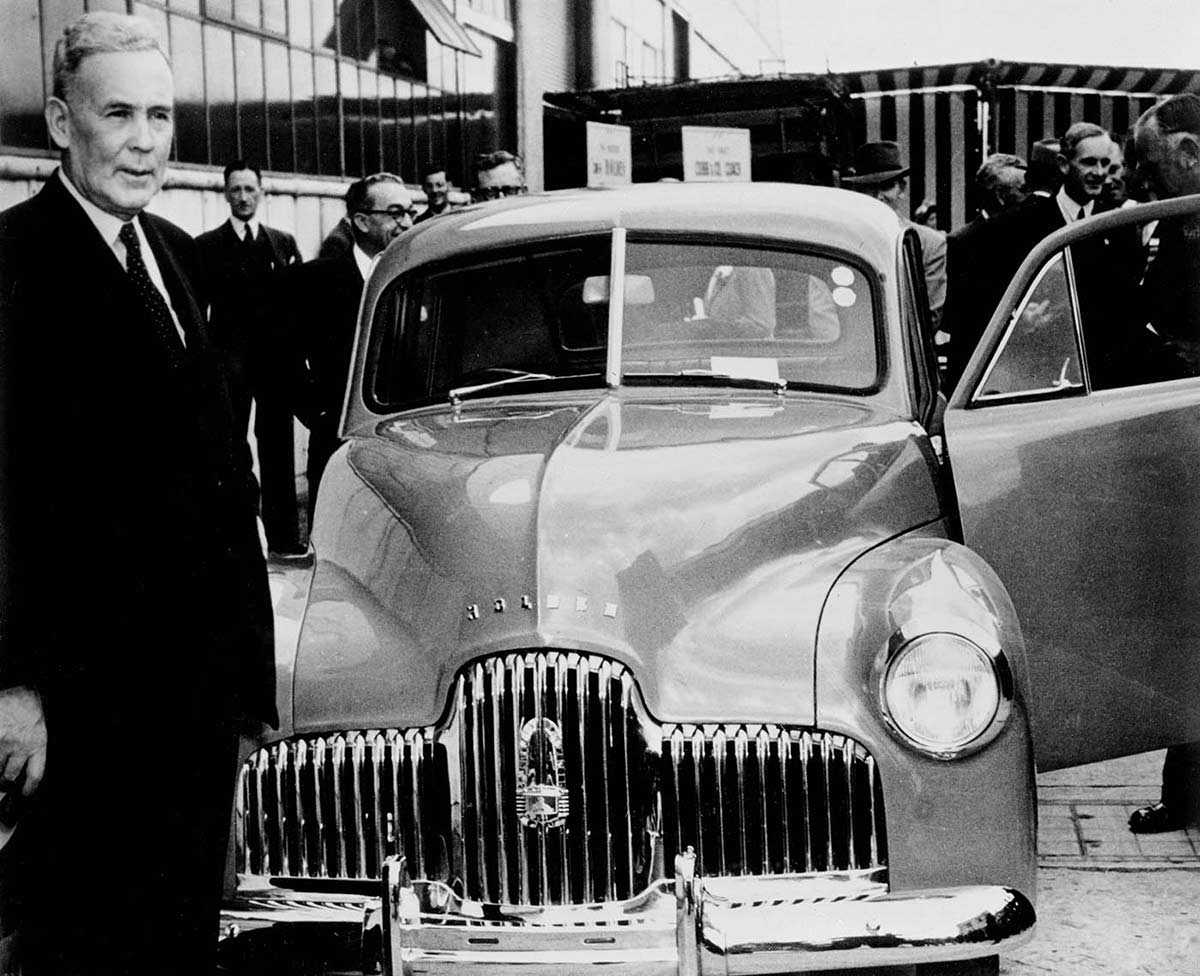
Picture this. It’s November 29, 1948. Silver curtains part in a social hall at Fishermans Bend, Melbourne, while an orchestra plays Brahms in the background. Prime Minister Ben Chifley stands before 1,200 guests, the spotlights catch a cream-coloured sedan sitting on black velvet, and a moment is born that Australia has never quite stopped talking about.
The Holden 48-215. The car Australians simply called “the Holden.” The car that became known as the FX – and, with the greatest of affection, the “Humpy.” That last nickname said everything: a nod to the car’s distinctive rounded, hump-backed roofline, that egg-shaped silhouette tapering down at both ends that made it instantly recognisable from a kilometre away. Only Australians could turn a car’s most obvious physical feature into a term of endearment. And the Humpy, over 75 years later, still makes every petrolhead in the country go a little weak at the knees.
Born From a Big Australian Dream
The story of the FX didn’t start in a factory. It started in a conviction – that Australia deserved a car designed for Australia.
Before the 48-215 arrived, Australian motorists were stuck choosing between oversized American gas-guzzlers and undersized British cars that wilted on rough outback roads. Holden’s Managing Director Laurence Hartnett had a different vision. As early as 1944, while the war was still being fought, he was working with a team of GM engineers on both sides of the Pacific to design a car built for local conditions – the heat, the dust, the long distances, and the corrugated roads that would shake a lesser vehicle to pieces.
The result was a car that felt like it genuinely belonged here. The first Holden defined the Australian car. Before it was launched, Australian motorists were served up a diet of big American cars or small British ones, but the Holden fell between the two available extremes and set the mould for the future Aussie car. It was the Goldilocks car – not too big, not too small, and made for exactly the country it was sold in.
Why Australians Went Absolutely Mad For It
The demand was extraordinary. By 1950, Holden had increased production to 80 units per day. By the end of December 1951, the Holden had become the nation’s top-selling car, with 21,184 registered in 1951. By the time the 100,000th example rolled off the line in May 1953, it had become a genuine phenomenon – not just a car, but a symbol of national confidence in the post-war years.
And why not? Here was a car Australians had helped design, built in Australia by Australian workers, and priced within reach of ordinary families at £733. It seated six across its bench seats, returned a respectable 8.9 litres per 100km, and was appreciated for its ruggedness, zippy performance and economical running.
Under the bonnet sat a 2.15-litre inline-six producing 60 horsepower, mated to a three-speed manual with the gearstick mounted on the steering column – thoroughly modern for its era. Top speed was around 130 km/h. No, it wasn’t fast. But it was yours. It was Australia’s.
What Changed Between 1948 and 1953?
The 48-215 ran for five years, and it wasn’t entirely static during that time. The most meaningful change — and the one that spawned the famous “FX” nickname itself – came in 1953.
The original 1948 models used lever-action shock absorbers in the front suspension. In 1953, GM-Holden introduced telescopic shock absorbers at the front, which dramatically improved the ride and handling. This designation “FX” was first used in the Drawing Office at GM-H in 1952 as an unofficial means of distinguishing between early 48-215 vehicles with front suspension using lever-action shock absorbers, and those with the new telescopic shock absorber front suspension introduced in 1953 – the term “FX” was pencilled onto a parts list for the new suspension components. The nickname stuck, eventually working its way into used-car advertisements and common usage across the country.
Throughout the production run, minor refinements were made to body trim, colour options, and interior fittings as Holden responded to customer feedback and worked to improve the car. A utility version – the 50-2106 – joined the lineup in 1950, bringing the same Holden ruggedness to working life on farms and in small businesses.
The 48-215 and 50-2106 models were replaced by the Holden FJ series in October 1953, with a total of 120,402 examples built across the entire run.
More Than Just a Car
The FX was never just transportation. It was proof – to Australians and to the world – that this country could build something great with its own hands. It arrived at exactly the right moment in history, when a nation emerging from the shadow of World War II was hungry for exactly that kind of pride.
Today, a well-preserved FX is a genuinely valuable classic – a good original example can command $25,000 or more, with rare early-numbered cars worth many hundreds of thousands of dollars. But its real value was never in the money. It was in the moment those silver curtains parted and Ben Chifley showed Australia what it was capable of.
The FX set the mould. Everything that followed – every Holden Torana, Monaro, Commodore, and ute – grew from that single cream sedan under the spotlights at Fishermans Bend. Not bad for a Humpy.