
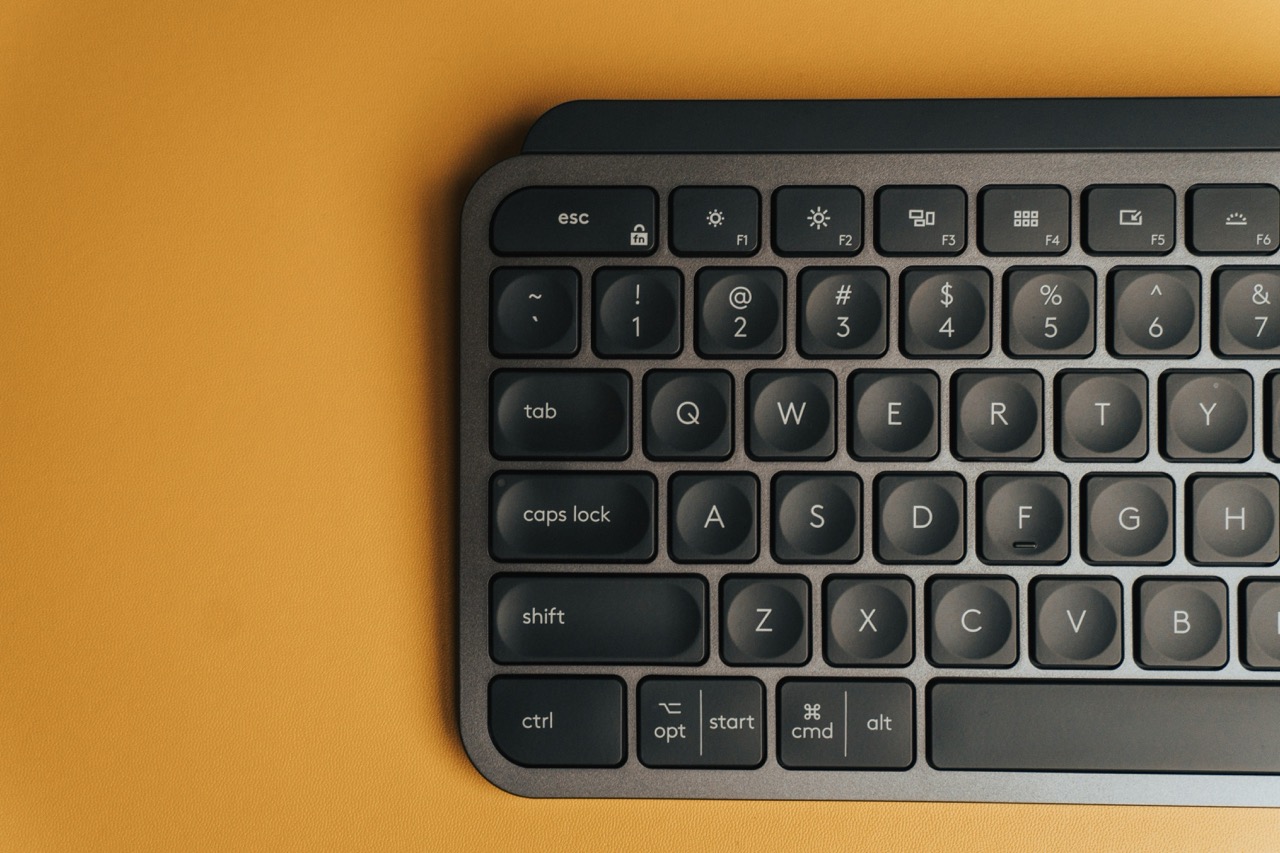
You’ve probably heard the story. The QWERTY keyboard – the one your fingers are resting on right now – was deliberately designed to slow typists down. Old mechanical typewriters would jam if you typed too quickly, so the keys were scrambled to keep your fingers from flying and breaking the machine. A neat, satisfying piece of design history.
Except it’s not quite true.
The real story of QWERTY is stranger, messier, and far more interesting than the myth – because it’s actually a story about how the world gets stuck with second-rate solutions, why better alternatives don’t automatically win, and what happens when a technology outlives the problem it was built to solve.
The Man Who Started It All
Christopher Latham Sholes was a newspaper editor and printer in Milwaukee, Wisconsin – not an engineer, not an efficiency expert, and certainly not someone with a master plan to frustrate future office workers. In the late 1860s, he started tinkering with a typing machine in a local machine shop with a couple of collaborators. His first keyboard layout? Alphabetical. Straightforward. Logical. The kind of thing a reasonable person would design.
The alphabetical layout turned out to have problems – not because it was too fast, but because of how early typebars worked mechanically. When certain pairs of letters were struck in quick succession, the metal arms would swing up and collide, jamming the machine. Sholes began rearranging letters to separate the most commonly struck pairs, reducing the frequency of those collisions.
But here’s the crucial detail that demolishes the myth: there is no hard proof that anyone sat down and deliberately engineered QWERTY to make typing slower. The goal was to solve a mechanical jam problem, not to sabotage human speed. And the proof? If the goal were truly to slow people down, QWERTY does a poor job of it – some of the most common letters and pairings still sit on the home row and under the strongest fingers.
The “slow typists down” story is a simplification that somewhere along the decades became stated fact. The myth is clean. It has a clear motive, a clear villain, and a clever twist. The real explanation is messier and less satisfying – which is precisely why the myth spread so easily while the real story stayed buried.
The Telegraph, Remington, and a Sales Trick
The real history is a tangle of competing forces.
Research suggests that Sholes’ early keyboard was partly shaped by telegraph operators – the professional typists of the 1860s. The original use was in telegraphy, and it would have been nonsensical to design a system that slowed Morse receivers down so they couldn’t keep up with the sender. The layout was built around what telegraph workers already knew, not around making life harder for them.
When Sholes sold his design to the Remington company, things changed further. The keyboard layout on Sholes’ original prototype was altered by the mechanics at Remington, who had their own manufacturing constraints and practical concerns. Then in 1886, a new company called Wyckoff, Seamans & Benedict released the Remington Standard Typewriter No. 2. To avoid existing keyboard layout patents, the company slightly altered the design, placing M next to N and swapping C and X. This became the QWERTY format we use today.
So the keyboard you’re using right now is not the product of a single genius decision. It is a stack of compromises: an inventor’s experiments, telegraph operators’ habits, a factory’s mechanical adjustments, and a patent-avoidance shuffle by a company trying to stay out of court. The system reigned supreme not because of its innate efficiency but because of a compromise between inventors and producers.
There’s also a delightful footnote: some believe the arrangement was partly a tactic to sell more typewriters, as it allowed a salesman to handily type out the word “typewriter” – because all the letters are placed in the top row. Whether this is true or another myth is, appropriately, unclear.
Why Didn’t a Better Keyboard Win?
In the 1930s, a University of Washington professor named August Dvorak designed what he believed was a superior keyboard layout. He analysed the frequency of letters in English, placed all five vowels on the left home row and the most common consonants on the right, and built a layout designed for alternating hand use and minimal finger movement. Dvorak claimed significant improvements: up to 40% faster typing speeds, reduced errors, and less physical strain. Some studies from the 1940s supported these claims.
The Dvorak keyboard is still available today – it’s built into Windows and macOS and takes thirty seconds to enable. Real-world typing speed gains are modest, roughly 5% to 15% faster for most people, with the primary benefit being reduced finger strain and improved comfort over long sessions. It is, by most measures, a more ergonomically sensible layout.
And yet, almost nobody uses it. Why?
Because being right is not enough. Though the issue of jammed keys was resolved in later typewriter designs – notably the IBM Selectric and then word processors – the layout was already ingrained in the habitual memory of millions of typists. The promise of typing faster was insufficient motivation for trained typists to relearn this skill, and new typists were taught by teachers and books centred around QWERTY.
This is what economists call path dependence – the idea that once a technology becomes entrenched, the cost of switching away from it can outweigh the benefit of the alternative, even if the alternative is genuinely better. The fax machine kept fax machines alive for decades after email existed. The imperial measurement system persists in the United States long after the metric system became the global standard. And QWERTY survives on touchscreens, voice-to-text apps, and virtual keyboards that have absolutely no typebars to jam, no mechanical constraints whatsoever – purely because everyone already knows it.
The Keyboard That Solved a Problem That No Longer Exists
Here is the quietly absurd conclusion of the whole story.
QWERTY was a workaround for a mechanical limitation of 1870s typewriter hardware. Those typewriters no longer exist. The problem has been irrelevant for at least half a century. Many improvements have since been made in operating mechanisms so that they no longer require a key arrangement that is disabling and awkward to the typist. And yet here we are – every smartphone, every laptop, every tablet, every gaming keyboard in the world ships with the same arrangement of letters that a Wisconsin newspaper editor landed on while trying to stop metal arms from crashing into each other.
It is, if you think about it, one of the most successful design decisions in history – not because it was optimal, but because it was first. And first, in the world of standards, beats better almost every time.
The Takeaway
The lesson of QWERTY isn’t really about keyboards. It’s about how the world actually works. Rational, efficient solutions don’t automatically replace entrenched, imperfect ones. History, habit, and the sheer friction of change are forces as powerful as logic and evidence.
Your keyboard is a 150-year-old compromise, shaped by telegraph operators, patent lawyers, factory mechanics, and the unstoppable momentum of everyone just… continuing to use it.
And you will almost certainly use it for the rest of your life.
The myth says someone designed your keyboard to slow you down. The truth is odder and more unsettling: nobody designed it at all, really. It just happened – and then it stayed.