
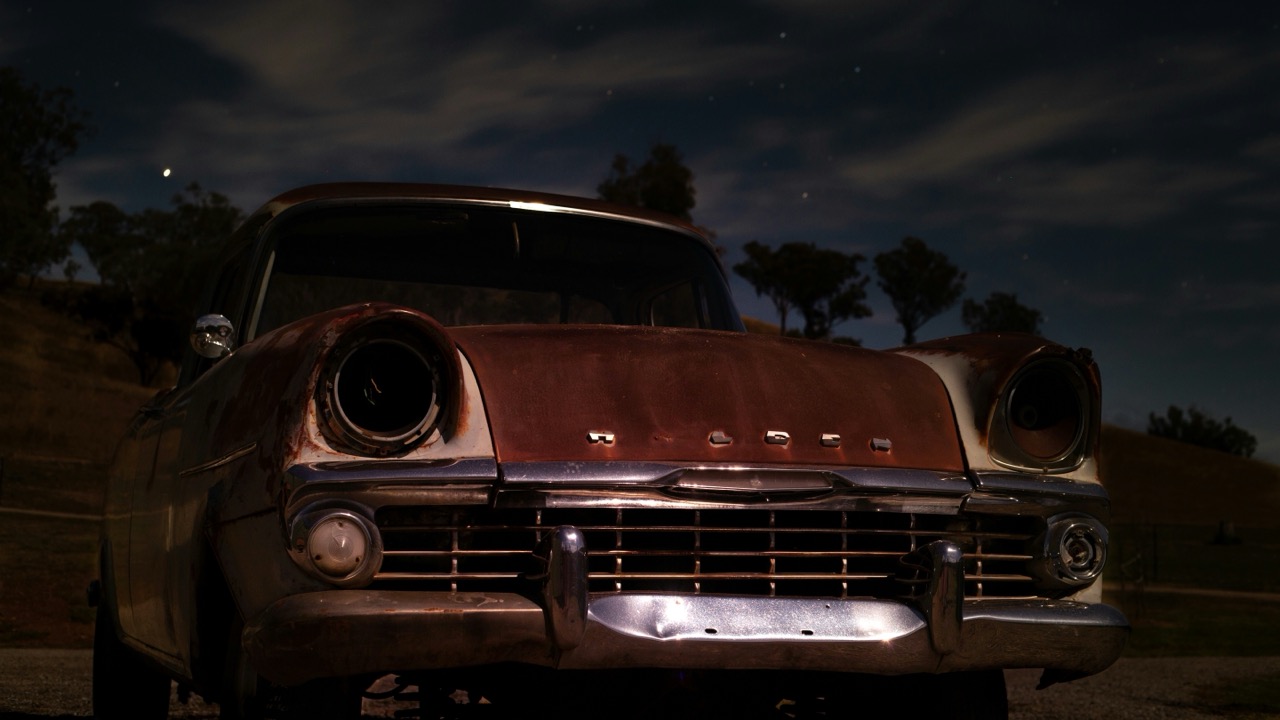
There are two kinds of Australians: those who know the difference between an EK and an EJ, and those who are about to find out.
The Holden story is the Australian story – built on post-war optimism, shaped by the open road, and mourned when the last car rolled off the Elizabeth line in 2017. From a cream-coloured sedan under spotlights at Fishermans Bend in 1948 to the final VF Commodore 69 years later, Holden gave this country something to be genuinely proud of. Here is every model, in order – the whole extraordinary run.
The F-Series (1948-1960) – Where It All Began
FX – Holden 48-215 (1948-1953)
The one that started everything. Unveiled by Prime Minister Ben Chifley on November 29, 1948, the 48-215 was instantly nicknamed the “FX” and the “Humpy” – the latter a nod to its rounded, hump-backed roofline. A 2.15-litre inline-six produced 60 horsepower, and three-speed column-shift was the order of the day. It became Australia’s best-selling car and put this country on the automotive map. A total of 120,402 were built before the FJ took over in 1953.
FJ (1953-1956)
Built on the FX’s foundation but significantly updated, the FJ brought a bolder chrome grille, increased power from the inline-six, and a new “Special” trim level. Still unmistakably a Humpy in silhouette, the FJ was nonetheless a step forward in comfort and refinement. With 169,969 built, it outsold the FX comfortably and cemented Holden’s position as Australia’s dominant car manufacturer. The Holden Efijy concept car of 2005 paid direct tribute to the FJ’s graceful lines.
FE (1956-1958)
The FE marked a genuine step change – Holden’s first fully restyled body since 1948. Gone was the rounded postwar silhouette; in came a more upright, modern American-influenced design with a wraparound windscreen and revised interior. Critically, the FE was the first Holden to offer a station wagon – introduced in March 1957, the Standard and Special Station Sedans gave Australian families the practical carrying capacity they’d been asking for. The FE also received an upgraded version of the reliable 132 cubic inch six and switched to modern 12-volt electrics. It was during the FE production run that Holden achieved a remarkable milestone: outselling the nearest competitor by two to one – in 1957 alone, 42.7 per cent of all passenger cars sold in Australia were Holdens. A total of 155,161 FEs were produced in just under two years.
FC (May 1958-January 1960)
A light reskin of the FE with a new front treatment, revised tail fins, and a push-button Hydra-Matic automatic transmission option – a genuine luxury for Australian motorists in 1958. The FC continued the FE’s station wagon body style (which Holden had introduced with the FE in 1957) and added more prominent chrome detailing and a bolder two-tone paint option. By the end of 1958, Holden’s market share had risen to a staggering 50.1 per cent. A total of 191,724 FCs were sold before the model was replaced by the FB.
The E-Series (1960-1965) – Growing Up
FB (1960-1961)
The FB was a significant evolution – lower, wider, and more confident-looking than its predecessors, with American-inspired tail fins that felt very much of its era. A new wrap-around rear window improved visibility, and the interior received a proper update. Short-lived at just 18 months, the FB was replaced quickly as Holden kept up with changing tastes, but it’s fondly remembered as one of the most elegantly styled of the early models.
EK (1961-1962)
The EK was a refinement of the FB with an updated grille and interior improvements. The EK continued the station wagon body style (first introduced with the FE) and added Holden’s first proper heater as standard equipment. Another short production run – just over a year – but the EK marked steady, confident progress.
EJ (1962-1963)
The EJ brought the biggest styling update since the FE – a completely new, more squared-off body that moved Holden firmly away from the rounded Humpy era. It looked like a proper 1960s car. Under the skin, the same 2.25-litre six continued, but refinements to the suspension improved ride quality noticeably. Enthusiasts today rate the EJ as one of the most handsome Holdens of the early 1960s. Around 157,000 were built.
EH (1963-1965)
Widely regarded as one of the finest-looking Holdens ever made and one of the most important. The EH was the first Holden to replace the long-running grey motor with the all-new red motor – available as a 149 cubic inch (2.4-litre) base unit and a 179 cubic inch (2.9-litre) in the more powerful variants – a significant leap in performance and modernity. It also introduced the S4 performance variant, the spiritual ancestor of the V8 Supercars era. At its launch in 1963, the EH broke Australian records by selling 100,000 units in its first year. The crisp, clean-lined body remains a favourite among restorers today, and an original EH in good condition commands serious money.
The HD to HG Series (1965-1971) – Power and Presence
HD (1965-1966)
The HD was Holden’s first genuinely large car, longer and wider than anything that came before. It also introduced the legendary 161 cubic inch (2.64-litre) “red motor” six-cylinder engine – one of the most durable and beloved powerplants in Australian automotive history. The red motor would go on to power Holdens for over two decades. The HD also brought disc brakes to the front for the first time, a major safety step forward.
HR (1966-1968)
A restyled evolution of the HD with softened front guards, a wider rear window, and a wider track that finally addressed handling criticisms of the HD. The HR is the last of the traditional pre-HK Holden lineage – the last model before the HK introduced the V8 and a completely new body direction. It was also the last pre-HK Holden, meaning every Holden from the FX through to the HR used variants of the upright Australian-designed body architecture that began in 1948. Over 252,000 HRs were built in just 22 months, making it one of the highest-volume models of the era.
HK (1968-1969)
A landmark model. The HK was the first Holden to offer a V8 engine – a 307 cubic inch (5.0-litre) Chevrolet-sourced unit that transformed what a Holden could do on the road and the track. It was also the first Holden to carry the Kingswood, Brougham, and Premier nameplates, establishing a trim hierarchy that would persist for years. The HK Monaro coupe arrived in this series too, instantly becoming a performance icon.
HT (1969-1970)
A styling refresh of the HK with a more aggressive front grille and revised rear treatment. The HT continued the HK’s V8 legacy and gave birth to the legendary Monaro GTS 350 – a 350-cubic-inch muscle car that became one of Australia’s great performance icons. The HT Monaro in particular is now one of the most collectible Holdens ever made.
HG (1970–1971)
The HG was the final evolution of the HK/HT body style – a modest update with revised trim and minor mechanical changes. It’s best remembered as the model that carried the Monaro name through to the HQ revolution. The HG also featured some significant safety improvements in response to emerging government standards. Total HG production was around 68,000 vehicles.
The HQ to WB Series (1971-1984) – The Classic Era
HQ (1971–1974)
One of the most significant Holdens ever made. The HQ was a ground-up redesign – longer, lower, wider, and more aerodynamic than anything that came before. It introduced the first fully independent rear suspension on a mainstream Holden sedan, vastly improving ride and handling. The HQ Kingswood, Monaro, Premier, and Statesman were all produced from this platform. The Sandman panel van also arrived during this era – the quintessential Australian youth car of the 1970s.
HJ (1974-1976)
A styling evolution of the HQ, easily identified by its squared-off front end with wraparound indicator lights. The HJ brought revised suspension tuning and updated interior trim across the Kingswood, Monaro, Premier, and Statesman ranges. The Sandman continued in wild-pattern glory. Total HJ production: 176,202 vehicles. The HJ represents the peak of Holden’s large-car dominance before the 1970s fuel crisis began reshaping Australian motoring tastes.
HX (1976-1977)
A reskin of the HJ with a new front treatment featuring twin rectangular headlights. Engines were refined and safety equipment improved. The HX was also the last Holden to offer the Monaro nameplate — that beloved performance coupe – until its revival in 2001. Only 85,000 HXs were built in a short production run, making them increasingly collectible today.
HZ (1977-1980)
The last of the traditional large-body Holdens before the Commodore arrived. The HZ received further styling and mechanical updates, but the writing was on the wall – the 1970s oil crisis had fundamentally changed what Australian buyers wanted. Even after the HZ was retired, its body style lived on in the WB commercial and Statesman ranges. A transitional car at the end of a golden era.
WB (1980-1984)
The WB was the commercial and fleet continuation of the HZ body architecture – panel vans, utilities, and the Statesman were kept alive on the old platform while the Commodore carried the sedan torch. The WB marks the end of Holden’s panel van era, and the last ute until the Commodore-based VG ute arrived. A total of 60,231 WBs were built before the line ended in late 1984.
The Commodore Era (1978-2017) – Australia’s Car
VB (1978–1980)
The original Commodore – smaller, lighter, and more economical than the Kingswood, designed in the wake of the fuel crisis. Based on a German Opel platform but with Australian running gear, it divided opinion on release. Some felt it was too small. History proved them wrong. The VB established the nameplate that would go on to become one of the most iconic in Australian motoring history.
VC (March 1980-October 1981)
A significant update with a revised “eggcrate” style grille, improved ride quality through revised spring and damper rates, and the introduction of cruise control. The VC also added a 1.9-litre four-cylinder engine to the lineup, broadening the model’s appeal to economy-conscious buyers. It was the best-selling car of 1980 with over 121,000 sold in its 18-month production run, and continued to build the Commodore’s reputation as a genuinely capable everyday car.
VH (1981-1984)
The VH brought more power, more refinement, and the first Commodore with fuel injection available. Peter Brock’s championship success in Commodore racecars during this era made the VH the car every young Australian wanted. The SS (Super Sports) variant returned with this model, carrying a performance pedigree that would define the Commodore name for the next three decades.
VK (1984-1986)
A major restyling that gave the Commodore a cleaner, more European look. The VK introduced the Calais luxury model to the lineup and carried the iconic HDT Brock Director – one of the most controversial and celebrated performance cars of the era. The falling-out between Peter Brock and Holden over the Director’s “Energy Polariser” unit made automotive news around the world.
VL (1986-1988)
The VL was the most comprehensively updated Commodore since the original VB. Every panel forward of the A-pillars was new, and the interior received its biggest makeover to date. Most significantly, the VL was the first Commodore without the long-running Australian-made Holden six – the move to unleaded fuel from January 1986 meant the old pushrod six couldn’t be converted economically, so Holden sourced Nissan’s modern 3.0-litre RB30E inline-six instead. Six months after launch, the turbocharged RB30ET arrived to create the legendary VL Turbo – now one of the most sought-after classic Holdens, its turbo six iconic in the street-car scene. A 5.0-litre V8 remained available for those who wanted it.
VN (1988-1991)
A ground-up redesign using GM’s new global V platform. The VN brought flush body panels, a modern interior, a new 3.8-litre V6, and the legendary 5.0-litre V8 in improved form. It also introduced the Berlina and Calais trim levels that would become synonymous with the Commodore lineup. The VN was a pivotal model — it dragged the Commodore confidently into the modern era.
VP (1991-1993)
A cosmetic and mechanical update of the VN with revised front styling, improved safety equipment, and refinements to the drivetrain. The VP introduced driver-side airbags as an option – a first for an Australian-built car. Semi-trailing arm independent rear suspension became standard on higher-spec models, significantly improving handling dynamics.
VR (1993-1995)
A substantial update with new exterior styling, upgraded interior, and improved safety features. The VR introduced anti-lock brakes more widely across the range. The Holden Special Vehicles (HSV) division continued to produce performance variants that became legendary on both road and track. The VR Senator was considered one of the finest large Australian sedans of its era.
VS (1995-1997)
The VS brought further refinements and marked the sales peak of Holden’s rivalry with Ford. The VS Commodore was Australia’s best-selling car throughout its production run. The V8 continued to deliver exceptional performance, and HSV models like the GTS set new benchmarks for Australian performance cars. Over 200,000 VS Commodores were produced in just two years.
VT (1997-2000)
A landmark model – the most advanced new vehicle program Holden had ever undertaken, representing a $600 million investment. The VT brought a completely new body, significantly improved crash protection, better NVH (noise, vibration, harshness) characteristics, and a new 3.8-litre Ecotec V6. It was the first Australian car to receive five-star ANCAP crash test results. The VT firmly repositioned the Commodore as a world-class vehicle.
VX (2000-2002)
An important update of the VT that introduced Bosch ABS as standard across all variants – a first for an Australian-manufactured car. The VX also spawned the production revival of the Monaro coupe, which helped launch Holden’s export program to the United States where it was sold as the Pontiac GTO. Traction control became available with manual transmissions for the first time.
VY (2002-2004)
The $250 million VY mid-cycle update brought the first major styling shift since the VT. Revised exterior design, updated interior, and improved refinement throughout. The VY Ute – a beloved Australian icon – continued in production. HSV reached new performance heights with the GTS and Clubsport models. The VY Monaro continued its US export success as the Pontiac GTO.
VZ (2004-2006)
A significant engineering update with a new all-alloy 3.6-litre V6 replacing the aging Ecotec, and refined V8 options. The VZ brought improved handling, ride quality, and interior quality. It also marked the final evolution of the third-generation Commodore platform before the VE’s complete redesign. Electronic stability control was introduced across more of the range.
VE (2006-2013)
The first Commodore designed entirely in Australia – not based on an adapted European platform – at a reported development cost exceeding $1 billion. The VE was widely acclaimed on its release, praised for its engineering sophistication, ride quality, and driving dynamics. It was exported to the United States as the Pontiac G8 and to the UK as the Vauxhall VXR8. The VE Series II update of 2010 brought further refinements. Widely regarded as the finest Commodore ever built.
VF (2013-2017)
The last Holden made in Australia. The VF brought updated styling, a new interior, and continued engineering refinements. The VF Series II of 2015 was the last major update before the Elizabeth plant closed on 20 October 2017. The final VF Commodore off the line was a specially finished VFII in Slipstream Blue, handed over to the National Museum of Australia. It was the end of a 69-year era – and Australia has never quite stopped mourning it.
The Takeaway
From the 60-horsepower Humpy to the 304-kilowatt HSV GTS, the Holden story is one of constant evolution in response to Australian conditions, Australian tastes, and Australian pride. Every model code carries a story, a generation, a memory. Whether you learned to drive in a VP, raced a VL Turbo, or simply grew up watching the Commodore dominate Bathurst – you were part of it.
They don’t make them anymore. But they made enough to last a lifetime of memories.
Australia’s Own. Always.